Nous partons dans les vignes pour quelques jours afin de découvrir de nouvelles pépites.
Les expéditions sont suspendues du 1 au 24 août. Toutes les commandes sont bien prises en compte pendant cette période
En vous remerciant de votre confiance

 close
close

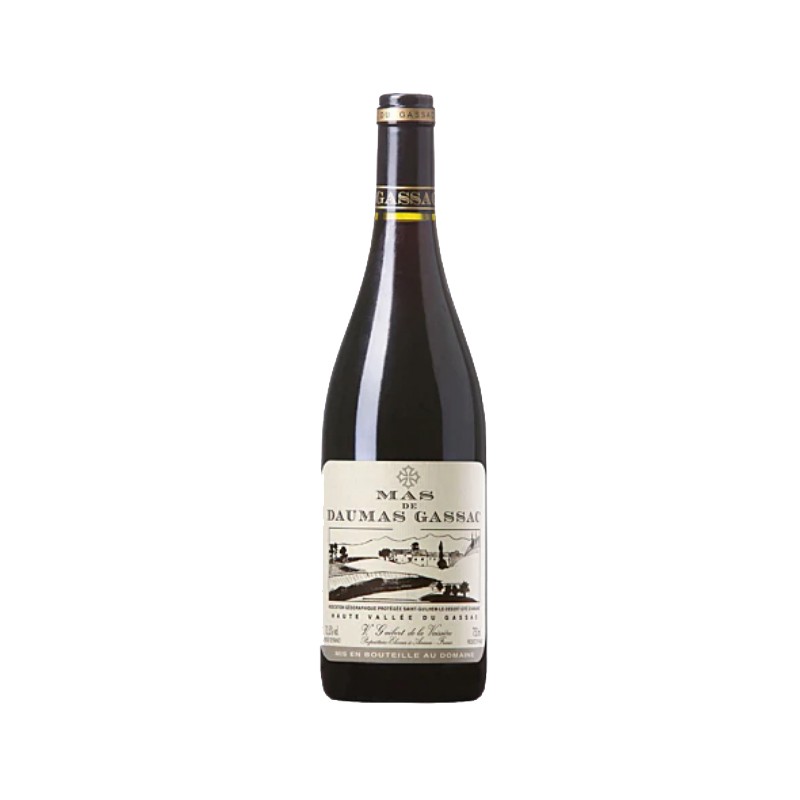
This Daumas Gassac rouge is a great success from the 2023 vintage: this organic gourmet wine develops notes of mocha, blackcurrant, cocoa, all resting on very elegant, fine tannins. Great length!
There are wines that change the history of a region. Mas de Daumas Gassac Rouge is France's most striking example. It all began in 1971, when Aimé and Véronique Guibert bought an old, abandoned farmhouse in the upper Gassac valley, on the outskirts of the medieval village of Saint-Guilhem-le-Désert. Their friend Professor Henri Enjalbert - a geologist specializing in the relationship between soil and grapes - analyzed the land and delivered a staggering verdict: these red glacial sandstones, rich in mineral oxides and poor in organic matter, formed by Ice Age scree, constitute one of the most singular terroirs in France, comparable to the best plots in Burgundy. The valley's exceptional microclimate - strong thermal differences between day and night, cold winds from the Larzac plateau, cold underground springs - completes Enjalbert's conviction: grapes of great nobility must be planted here.
.In 1972, 17,000 uncloned Cabernet Sauvignon grafts - as it reigned in the Médoc before 1914, from the best Bordeaux estates - were planted. In 1978, the first vintage was vinified under the guidance of Émile Peynaud, the legendary oenologist who at the time advised Château Margaux, Haut-Brion and La Mission. Mas de Daumas Gassac Rouge was born, and with it, the renaissance of Languedoc winegrowing. In 1997, the wine was served in London at a dinner attended by Bill Clinton and Tony Blair - its worldwide reputation was definitely established.
Today, Aimé's sons - Samuel, Gaël, Roman and Basile - carry on the legacy with the same rigor. The 40-hectare vineyard is organized into some fifty small clearings of half to one hectare, encircled by 1,500 hectares of preserved garrigue forest - a natural setting that provides unique biological protection. The estate has been farmed organically, without chemical fertilizers, since the beginning.
The 2023 comes from a vintage marked by severe drought - 30% less rainfall than average. Thanks to the valley's microclimate and the care taken with the vines, the grapes ripened slowly and healthily despite the heatwave, with remarkable natural concentration. The 2023 blend is composed of Cabernet Sauvignon (75%), Merlot (5%), Pinot Noir (5%), Tannat (4%), Cabernet Franc (2%), Petit Verdot (2%), and rare varieties (7%): Nielluccio, Montepulciano, Saperavi from Georgia, Carménère from Chile, Tempranillo from Spain, Abouriou from France. Hand-harvested from August 31 to September 13, 2023 over 8 days, yield 30 hl/ha.
Vinification is classic Médoc: slow extraction, delicate pumping-over and infusion, long fermentation and maceration, no filtration. Aged 12 to 15 months in oak barrels aged 1 to 7 years. The 2023 explodes on the palate with notes of mocha, blackcurrant and cocoa, a symphony of varietals of majestic complexity, elegant and very fine tannins, a velvety, powerful and unctuous finish.
Must be decanted 2 to 4 hours before serving, balloon glass, between 18 and 19°C. Put the cork on the decanter while decanting. For large parties, uncork half a day in advance. Pairings: herb-crusted lamb, game birds, matured prime rib, black truffle, mature hard cheeses - comté, beaufort, ossau-iraty.
Discover also the Mas de Daumas Gassac Blanc 2023 - the estate's other legend, a blend of 13 grape varieties on Lutetian limestone.
Data sheet
75% Cabernet Sauvignon, 5% Merlot, 2% Cabernet Franc, 2% Petit Verdot, 5% Pinot Noir, 4% Tannat, 7% rare varieties: Nielluccio, Montepulciano (Italy), Saperavi (Georgia), Carménère (Chile), Tempranillo (Spain), Abouriou (France).
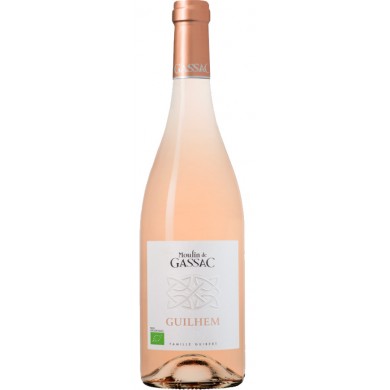
Guilhem Rosé 2025 from Moulin de Gassac is the winery’s organic rosé—vibrant, floral, and mineral—crafted from grapes grown on the hillsides surrounding the Thau Lagoon.
The color is a luminous coral with salmon-colored highlights. The nose is pleasant and intense, floral and mineral with citrus notes. On the palate, it offers a beautiful balance of freshness, combining aromas of red currants and red berries, with a crisp and lingering finish. Serve between 10 and 12 °C.
Organic Carignan and Grenache, grown on a clay-limestone plateau bordering the Thau Lagoon. 100% destemming, direct pressing, low-temperature fermentation, yield 50–60 hl/ha.
Best enjoyed within 2 years. Pairs well with salads, grilled meats, and fish.
Close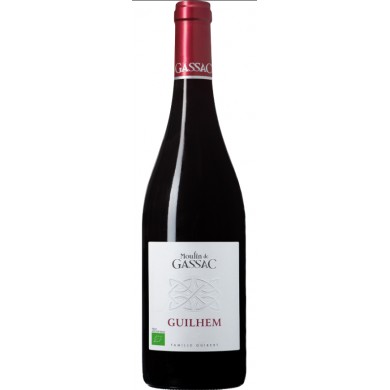
The 2025 Guilhem Rouge from Moulin de Gassac is the estate’s organic red wine—fruity, supple, and spicy, grown on the limestone slopes of Villeveyrac.
The color is an intense, deep red. The nose reveals aromatic complexity combining notes of red fruits and spices. On the palate, it offers a supple and fruity attack, with well-integrated tannins—a wine full of finesse. Serve between 18 and 20 °C, after lightly decanting.
Organic Alicante, Carignan, and Merlot from the Jurassic limestone slopes rich in bauxite, Villeveyrac. 100% destemmed, traditional winemaking, 10–12 days of maceration at 25–30 °C.
Best enjoyed within 3 years. Pairs well with meat and cheese.
Close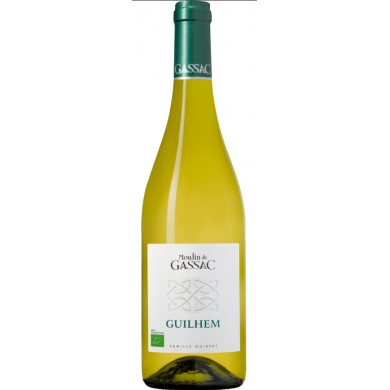
The 2025 Guilhem Blanc from Moulin de Gassac is the winery’s organic white wine—an original blend of three Mediterranean grape varieties, "a total crowd pleaser."
The color is light, clear, and brilliant. The nose is alluring and intense, with notes of white flowers, citrus, and white-fleshed fruits. The palate is lively and fresh, with a mineral finish. Serve between 10 and 12 °C.
40% Grenache Blanc, 30% Colombard, 30% Rolle (organic), grown on clay-limestone terraces bordering the Thau Lagoon. Skin contact for 2–3 hours in a refrigerated tank; fermentation at 16–21 °C; aged for 5–6 months in stainless steel tanks, without oak.
Best enjoyed within 2 years. Pairs well with fish, shellfish, and fresh goat cheese.
Close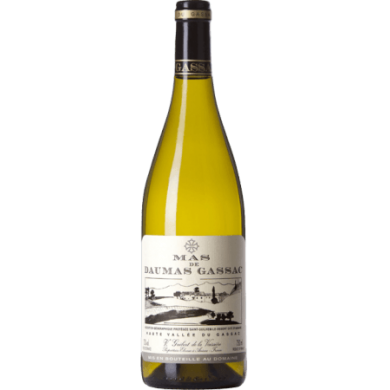
Le Mas Daumas Gassac blanc is made from a unique blend of grape varieties: this pure, incredibly fresh Languedoc organic wine develops on notes of yellow fruit, musk and menthol. Superb length. A great gourmet wine to be enjoyed over 15 years.
97/100 Jeb DUNNUCK
92+/100 Robert PARKER
91/100 Guide Bettane et Desseauve 2026
Close
This Daumas Gassac rouge is a great success from the 2023 vintage: this organic gourmet wine develops notes of mocha, blackcurrant, cocoa, all resting on very elegant, fine tannins. Great length!